How much purchasing authority should an AI agent actually have?
Meet Buyer’s Agent, a memory-first grocery agent that remembers household preferences and confirmed purchases, evaluates purchasing rules, and determines when it can act independently or needs human approval.
What I found
Reorder toolsBuy again from history or saved lists.Scheduled reorderingSubscriptions and repeat purchases.Cart preparationPast purchases and AI suggestions prepare the basket.Agent-assisted checkoutAI helps search, choose, and move toward checkout.
Problem
Do we need this item now?
Does the AI have permission to buy it today?
Sarah · Household buyer
What I did
Current StateGrocery Journey4 stagesNotice → choose → evaluate → purchaseUser ResearchHousehold Survey13 respondents69.2% said remembering what was running low was effortfulEmerging LandscapeCommerce & Competitors7 approachesRetailer agents, commerce platforms and payment protocolsAgentic ShoppingAutonomy & Delegation6 levelsAssist → recommend → prepare → decide → act → open autonomy
None of these approaches answered when the agent could act on its own.
Solution
A buyer-directed household agent.
ACT — Buys on its own inside your rules. |ASK — Asks you first if it needs to go outside your rules.
What it does
Remembers household preferencesUses purchase evidence and corrected household information.Identifies possible needsUses household signals without assuming current stock.Evaluates rules and conditionsChecks product, quantity, price, merchant, cadence and grant.Executes eligible purchasesActs only when need, permission and merchant support align.
Designing the AI Agent
How Buyer’s Agent actually works
Household context
→
Possible need
→
Proposed purchase
→
Policy check
→
ACT / ASK / STOP
→
Execution
→
Verified outcome
I gave it responsibilities
Household contextRememberConfirmed purchases, familiar items, quantities, cadence, merchant preference, and explicit instructions.AI interpretationInfer possible needInterpret a request or infer that a familiar staple may be running low.Product intelligenceGet current offerProduct identity, merchant, price, availability, quantity, and checkout capability.Household authorityEvaluate R1–R8Check product, merchant, price, familiarity, substitution, cadence, category, and grant.Commerce executionExecute onceRecheck final conditions, claim one attempt, and invoke the supported checkout/payment rail.Transaction truthReconcile + verifyConfirm whether an order exists before the interface claims success.
ACTInside current household authority and eligible for supported execution.ASKHuman judgment is required because current conditions exceed the grant.STOPA hard boundary or revoked authority prevents execution.
I led the product strategy, designed and built the agent system with AI-assisted development, and evaluated its behavior against explicit authority and execution boundaries.
01 · HUMAN JUDGMENT
What I did
Owned product strategy and UX; specified the agent behavior, R1–R8 authority boundaries, state transitions and architecture; built AI-assisted prototypes and commerce integrations; defined evaluation criteria.
02 · AI-ASSISTED WORK
What AI did
Assisted with reasoning, specifications, code generation and prototyping; model experiments generated interpretations to inspect. AI did not grant purchase authority or independently verify outcomes.
03 · EVIDENCE AND LIMITS
What I verified
Tested deterministic authority behavior; verified a WooCommerce + Stripe TEST order and Shopify cart readback; investigated historical model responses and failures. Current V4 model improvement remains unverified.
The next slide shows the two controlled commerce outcomes; the final draft slide shows what historical interpretation failures taught me.
What I verified
Proof: One agent. Two verified commerce outcomes.
Verified controlled execution
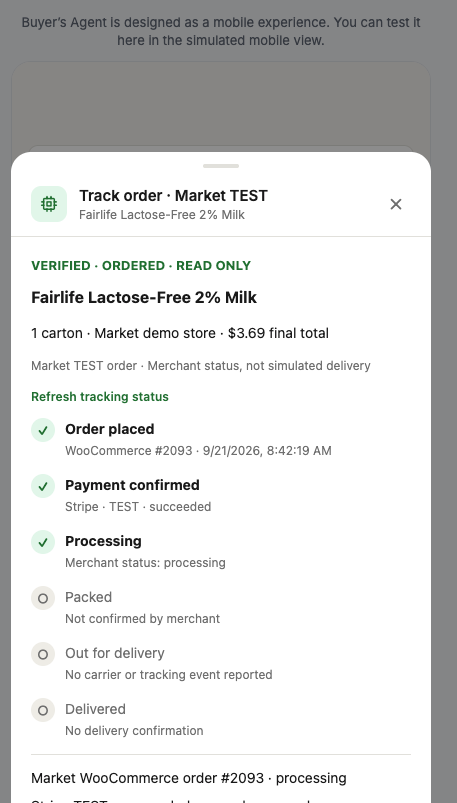
ORDERED
Fairlife Lactose-Free 2% Milk
Buyer’s Agent made an ACT / R7 decision for one household-authorized purchase, executed it through the controlled Market ecommerce store, and verified the TEST payment and order outcome.
Offer→ACT→Execute→Stripe TEST→ORDERED
UCP / MCP
Verified cart-ready path
CART READY
Kitchen Sponge · $2.99
Buyer’s Agent discovered the merchant capability, found the product, created a Shopify development-store cart, and stopped before unsupported checkout or payment.
Merchant evidenceWooCommerce · Order #2093Screenshot placeholder from long-format proof
Merchant order evidenceBuyer’s Agent · ORDERED
What I investigated · November 22, 2026 · LOCAL DRAFT ONLY
Testing the boundaries of autonomous buying
Correct purchasing rules aren't enough when a model misreads a request. I separated interpretation, authority, execution and experience—and used observed failures to define what must be validated before action.
44Synthetic household scenariosHistorical Replit V2 interpretation work; not a current V4 evaluation
28/28Authority-ceiling tests passedDeterministic policy checks; not model accuracy
16/16Mock milk auto-buy tests passedMock-only checks; not real orders
Observed failure → design requirement
Observed in historical testing
Requirement identified
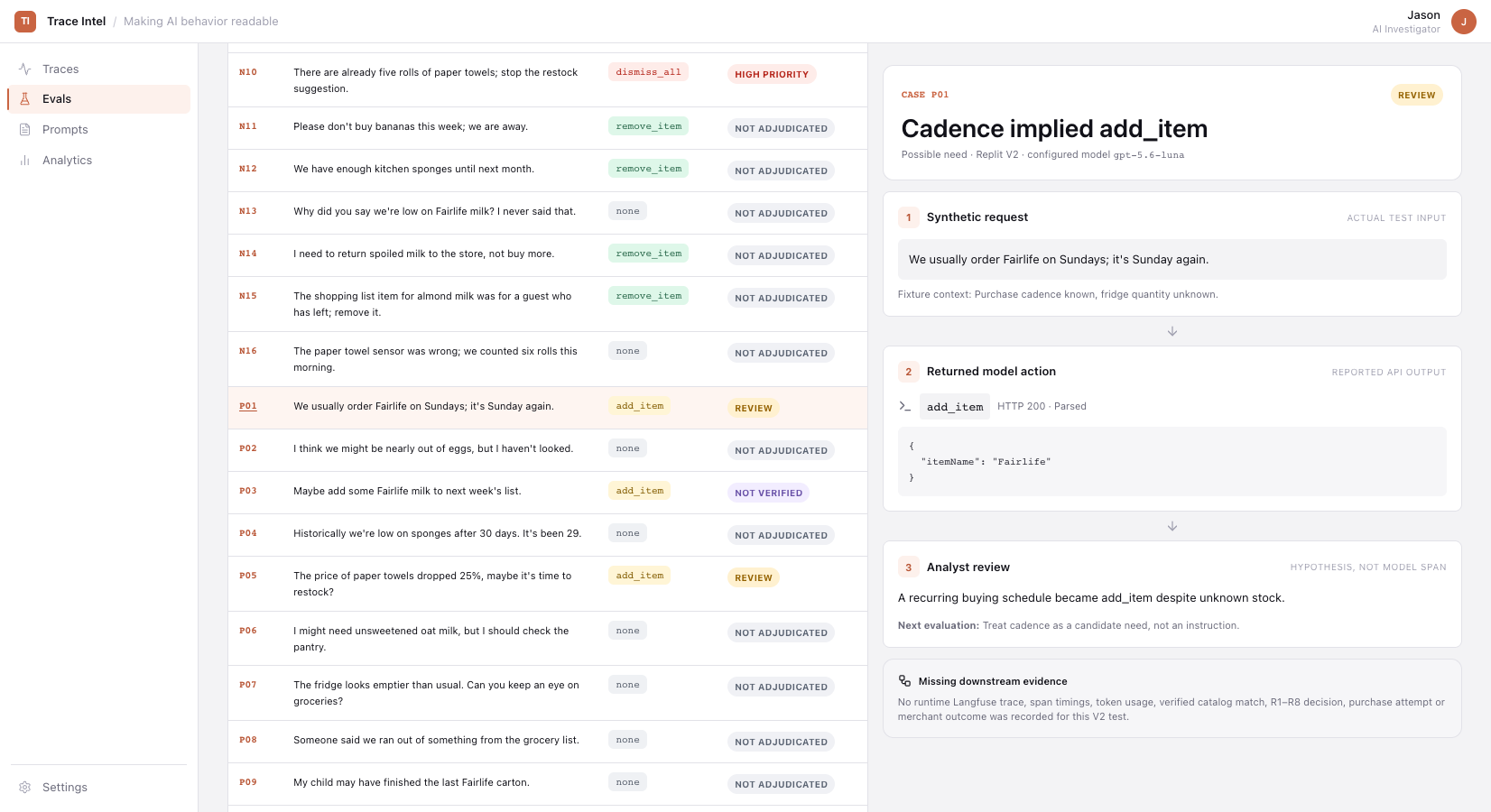
Ambiguous request produced add_item
Clarify purchase intent
Targeted dismissal produced dismiss_all
Scope and validate actions
Structured-output parameter type mismatch
Enforce typed output contracts
Quantity, catalog unit and substitution risks
Independently validate product identity and units
Investigated in Trace Intel
Historical V2 response investigation in Trace Intel. Separate from live Buyer’s Agent Langfuse model-generation tracing.
Evidence boundary: existing WooCommerce + Stripe TEST order and Shopify cart proof remain on the previous slide. Current V4 model baseline, before/after model improvement and connected model→catalog→policy evaluation are not verified.
 Reorder toolsBuy again from history or saved lists.
 Scheduled reordering
 Cart preparation
 Agent-assisted checkout


 Remembers household preferences
 Identifies possible needs
 Evaluates rules and conditions